
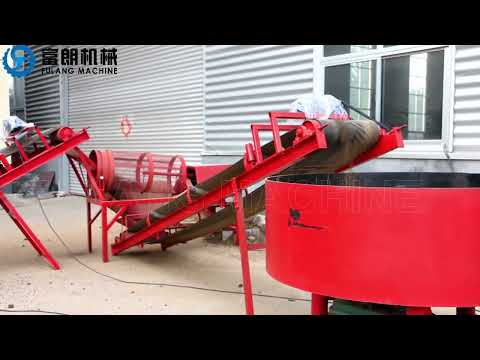
From a Pile of Soil to a Finished Brick
A finished brick looks simple.
The process behind it is not.
Before material ever reaches the brick press, it has already gone through several stages of preparation. Crushing, screening, conveying and mixing all affect what happens later inside the mold.
That is what makes the production line shown in this video useful to watch.
Instead of focusing only on the final pressing machine, the footage follows the material through the complete production process. You can see how raw material is prepared, transferred between different pieces of equipment and finally compressed into finished bricks.
For anyone considering a soil brick making machine, this is a much better picture of what real production involves.
Step 1: Breaking Down the Raw Material
The line begins with the crusher.
Raw soil is rarely ready to enter a brick machine directly. Depending on where it comes from, it may contain larger lumps or compacted pieces that need to be broken down first.
The crusher reduces those larger pieces into a more manageable size.
This matters because the next stages depend on reasonably consistent material.
If oversized lumps move further down the line, they can make mixing less uniform and may eventually affect the surface or density of the finished bricks.
It is one of those parts of brick production that receives less attention than the press itself, but good forming begins with good material preparation.
Step 2: Moving the Material Without Constant Manual Handling
Once crushed, the material moves onto a conveyor.
Conveyors may not be the most impressive equipment in a brick plant, but they make a noticeable difference to the way the line operates.
Without them, workers would have to move material from one machine to another manually.
That becomes slow and labor-intensive very quickly.
In the video, the conveyor connects the crusher with the next processing stage, allowing the material to move continuously through the line.
For a working plant, that continuity is important.
The main machine can only operate efficiently when material arrives at the right time. A production line is therefore only as practical as the way its individual machines are connected.
Step 3: Screening Out Oversized Material
After crushing, the soil passes through a screening unit.
The screen separates material according to particle size and helps prevent larger pieces from continuing into the mixing and molding process.
Why does that matter?
Because a brick mold works best with relatively uniform material.
Large particles can make it harder to achieve an even fill inside the mold. They may also create weak areas or an uneven surface in the finished product.
Screening improves control before the material reaches the mixer.
It also highlights an important point for anyone buying brick equipment: the brick press is not responsible for fixing every problem with the raw material.
The condition of the material before pressing matters just as much.
Step 4: Mixing the Prepared Material
The screened material then moves into the mixer.
This is where the prepared soil is blended before forming.
Depending on the brick formula and local production requirements, the mixture may include different materials and proportions. What matters is that the ingredients are distributed evenly before they enter the mold.
You can see the mixing blades working through the material in the video.
It is a simple process to watch, but it has a direct effect on the final brick.
If one section of the mixture contains noticeably more moisture or binder than another, the bricks coming out of the press may not behave consistently.
A well-mixed batch gives the forming machine a much better chance of producing repeatable results.
Step 5: Feeding the Brick Press
Once the material has been prepared and mixed, it is transferred toward the brick making machine.
This is where the production process changes from preparation to forming.
The press shown in the video uses a vertical hydraulic forming structure. Material enters the mold area, where it is compressed under pressure.
Unlike fired clay brick production, compressed soil brick manufacturing relies heavily on the forming stage to give the brick its density, dimensions and basic structural shape.
That makes pressure control and mold stability especially important.
A brick should not simply look right when it leaves the machine. The machine needs to repeat that result throughout the working day.
Step 6: Hydraulic Pressing and Brick Forming
The most interesting part of the video comes when the machine begins the pressing cycle.
The upper section of the press moves down toward the mold, compressing the prepared material.
Once the cycle is complete, the newly formed bricks are released and moved out of the forming area.
Several bricks are produced together in a single cycle.
What is worth watching here is not simply the speed.
Look at how the machine moves during pressing.
Look at how the mold releases.
Look at how the bricks sit after they leave the machine.
These details often tell you more about a brick machine than a headline production figure.
A machine may be advertised with an impressive theoretical capacity, but real production also depends on smooth feeding, reliable forming and consistent discharge.
What Finished Bricks Can Tell You About the Machine
Toward the end of the video, the finished soil bricks are visible on the conveyor.
This is where buyers should pay attention.
The bricks have clearly defined edges and a relatively consistent shape from one unit to another.
That consistency matters because brick manufacturing is repetitive by nature.
One good brick proves very little.
A useful machine has to produce similar bricks cycle after cycle.
For commercial production, dimensional consistency affects more than appearance. Uniform bricks are easier to stack, transport and use during construction.
Variations become more noticeable once hundreds or thousands of bricks are involved.
This is why production videos showing several finished bricks are often more useful than a staged photograph of a single sample.
Why the Complete Production Line Matters
Many first-time buyers focus almost entirely on the brick press.
That is understandable. It is the largest and most recognizable machine in the line.
But the video makes something clear: the press is only one part of the production system.
A complete soil brick production line may include:
- a crusher for breaking down raw soil;
- conveyors for material transfer;
- a screening unit for controlling particle size;
- a mixer for preparing a uniform material blend;
- the hydraulic brick making machine;
- a discharge or handling system for finished bricks.
If one stage cannot keep up with the others, the whole line slows down.
For example, installing a high-output brick press does not help much if the material preparation equipment cannot supply enough prepared mixture.
That is why equipment selection should be based on the entire process rather than the rated capacity of one machine.
Raw Material Should Come Before Machine Selection
One of the most useful questions a brick machine supplier can ask is:
What raw material do you have?
It sounds basic, but it affects almost everything that follows.
Soil conditions vary widely from one region to another. Particle size, moisture, clay content and other characteristics can influence preparation and forming.
The same machine configuration may not be ideal for every location.
Before choosing a soil brick production line, it is worth testing the available material and discussing the intended brick type with the equipment supplier.
That conversation should happen before the machinery is finalized—not after it arrives at the factory.
How Much Automation Do You Actually Need?
Automation is another area where buyers sometimes assume that more is always better.
Not necessarily.
A highly automated line can reduce manual handling and improve production continuity, but it also requires a larger investment and a more organized plant layout.
For some projects, a simpler line with a crusher, mixer and hydraulic press may be enough.
For larger operations, additional conveyors and automatic material handling can make much more sense.
The right level of automation depends on labor cost, target capacity, site conditions and how the factory will actually be operated.
The goal is not to build the most complicated line possible.
It is to create a production process that works reliably every day.
What to Look for When Watching a Brick Machine Test Video
A factory test video can be useful when comparing equipment suppliers, especially if an overseas buyer cannot visit every manufacturer in person.
Do not watch only the final ten seconds when the finished bricks appear.
Watch the entire process.
Pay attention to how the raw material is handled, whether the conveyors run smoothly, how the mixer operates and whether material enters the press consistently.
During forming, look for unnecessary movement or vibration around the machine.
After pressing, inspect the shape of several bricks rather than a single sample.
Also notice how easily operators can approach the machine for checking and routine maintenance.
These practical details are often more relevant to long-term production than polished product photos.
A Brick Production Line Is a System, Not a Single Machine
This video gives a useful overview of what soil brick manufacturing looks like when the different stages are connected.
The crusher prepares the raw material.
The screen controls particle size.
The mixer creates a more uniform blend.
Conveyors keep material moving.
And the hydraulic press turns the prepared mixture into finished bricks.
Each stage has a different job, but they all affect the final product.
For someone planning a new brick plant, the starting point should therefore be the production requirement itself.
What type of brick do you want to make?
What raw material is available locally?
How many bricks do you need to produce?
How much labor is available?
And how much automation makes sense for your project?
Once those questions are clear, choosing the equipment becomes much easier.
Because successful brick production is rarely about finding one impressive machine.
It is about putting together a line in which every part works well with the next.
Planning a Soil Brick Production Project?
Choosing the right production line starts with the material and the finished brick you want to produce.
Send us your raw material, brick dimensions, required output and preferred level of automation. Based on those details, we can recommend a suitable machine configuration and complete brick production solution.
Contact us for machine videos, technical details and a customized quotation.