
FL10-15 Mobile Automatic Block Machine: A Different Approach to Block Production
Most concrete block production lines are built around one idea: the machine stays in one place while pallets carry fresh blocks away.
The FL10-15 Mobile Automatic block machine takes a different approach.
Instead of relying on a fixed production position and a large number of pallets, the machine moves forward after each forming cycle and produces blocks directly on the prepared ground.
For manufacturers looking for a simpler production layout, that can make a noticeable difference.
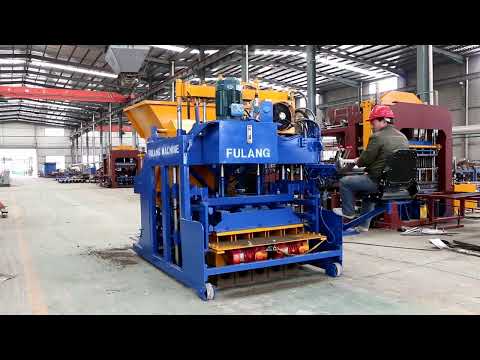
Why Does a Mobile Block Machine Move?
The FL10-15 belongs to the egg-laying type of block machine.
Once concrete has been fed into the mold and the block has been formed, the machine releases the fresh blocks onto the ground. It then moves forward to the next position and repeats the process.
There is no need to place every batch of blocks onto a production pallet first. FL10-15 product information specifically lists it as a pallet-free mobile machine with electric walking and hydraulic steering.
This changes the layout of the factory.
Instead of moving fresh blocks away from a stationary machine, the machine moves through the production area while the newly formed blocks remain behind for initial setting.
For some factories, especially where there is plenty of flat working space, this can simplify block handling significantly.
No Pallets Means Fewer Things to Manage
Pallets are easy to overlook when calculating the cost of a block production line.
A conventional automatic factory may require a large number of them. They need to be purchased, moved through the line, cleaned and eventually replaced when they become worn or damaged.
The FL10-15 avoids this part of the process because the blocks are formed directly onto the working surface.
That does not mean the site requires no preparation.
The production floor still needs to be reasonably flat, firm and suitable for fresh block placement.
But for the right project, eliminating pallets can reduce both initial investment and daily handling work.
Forming Quality Still Comes First
Mobility is useful, but it would mean little if the blocks themselves were inconsistent.
The FL10-15 uses hydraulic forming together with vibration during the molding process. Product information describes a dual-vibration arrangement involving the upper mold and lower mold area, intended to improve compaction and block density.
In practice, the quality of a finished block still depends on more than the machine.
The concrete mixture has to be prepared correctly.
Moisture needs to be controlled.
Aggregate size should suit the mold.
And the mold needs to fill consistently before forming begins.
A good block machine creates repeatable pressure and vibration, but it cannot completely compensate for a poor concrete mix.
Different Molds Give the Factory More Flexibility
A manufacturer may not want to produce the same block forever.
One market may require large hollow blocks for wall construction, while another customer needs smaller solid blocks.
The FL10-15 can produce different hollow and solid block designs by changing the mold. Published examples include 400 × 200 × 200 mm, 400 × 150 × 200 mm and 400 × 100 × 200 mm products, although the actual mold should always be selected around the buyer’s required dimensions.
This flexibility can be useful for factories serving several local construction markets.
It also means buyers should not ask only:
“How many blocks can the machine produce?”
The better question is:
“How many of my block size can it produce?”
Output changes according to the dimensions and number of blocks formed in each cycle.
Mobile Does Not Mean Manual
The FL10-15 is mobile, but that does not mean operators have to push it around the factory.
The machine uses powered movement, and product descriptions list electric walking together with hydraulic steering.
After one forming position is completed, the machine can move forward and begin the next cycle.
This is particularly useful on long, open production floors where blocks can be laid in organized rows.
The result is a different kind of automation from a fixed pallet-based production line.
Instead of automatically transporting every finished block away from the machine, the FL10-15 automates the movement of the machine itself.
What Kind of Factory Is the FL10-15 Best For?
This type of mobile block machine is particularly attractive when a buyer wants relatively high output but does not want the complexity of a full stationary pallet circulation line.
It can make sense where:
- there is enough level production space for ground curing;
- hollow or solid concrete blocks are the main products;
- pallet costs need to be reduced;
- the buyer wants automatic movement without installing a large fixed production line;
- simple factory layout is a priority.
For manufacturers producing high-value paving products with more complex surface requirements, another type of stationary production line may be more suitable.
The production method should always match the finished product.
Look Beyond the Main Machine
Even though the FL10-15 does not require production pallets, it still needs a reliable supply of concrete.
Product information commonly pairs the machine with a JS500 mixer, although the supporting equipment should be selected according to the required capacity and local setup.
Raw material storage, batching, mixing and delivery to the machine all need to keep pace with production.
If the block machine is waiting for concrete, its theoretical output does not matter.
This is why buyers should think about material flow before finalizing the equipment order.
A well-matched mixer and feeding arrangement can be just as important as the molding machine itself.
A Practical Alternative to a Fixed Production Line
The main appeal of the FL10-15 is easy to understand.
It combines automatic block forming with mobility and removes the need for pallets.
For some manufacturers, that means a simpler factory layout, fewer handling steps and lower supporting-equipment requirements than a conventional stationary line.
The right block machine is not always the most complicated one.
It is the machine that fits the available space, target block sizes, local labor conditions and expected production volume.
For factories with enough ground space and a focus on hollow or solid concrete blocks, the FL10-15 offers a production method worth considering.
Looking for a Mobile Block Machine?
Tell us your block dimensions, raw materials, expected daily output and available production area.
We can recommend a suitable FL10-15 mold configuration, mixer and supporting equipment based on your project.
Contact us for machine videos, technical specifications and a customized quotation.
Email: [email protected]
Whatsapp: +86 15318522755